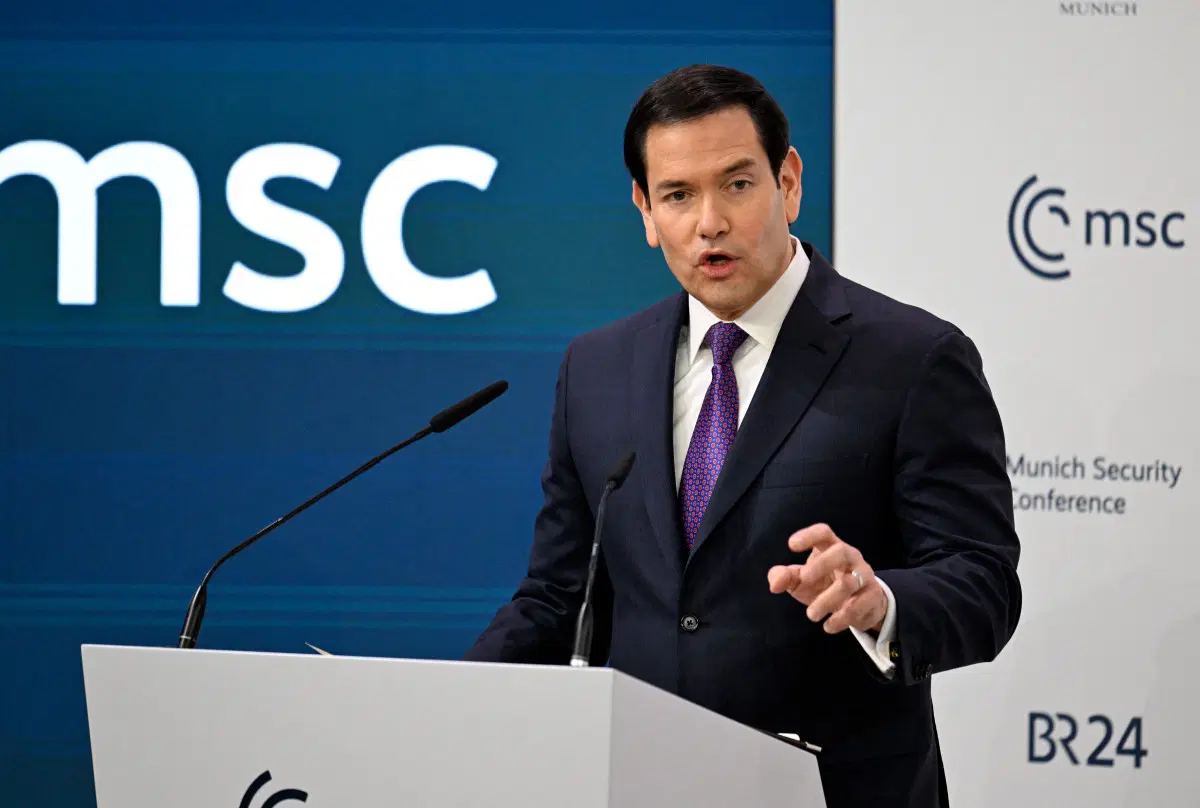

US Secretary of State Marco Rubio told European leaders that Washington wants to renew its alliance with the continent, but on terms aligned with President Donald Trump’s vision for a reshaped global order. Speaking at the Munich Security Conference, Rubio positioned the United States as committed to partnership with Europe while making clear that the framework would reflect the priorities of the Trump administration.
Addressing diplomats and security officials, Rubio described the United States as a child of Europe and said the two sides belong together. He offered what he framed as a renewed partnership, stressing that Washington would prefer to build a new world order alongside Europe rather than independently, though he underscored that the US was prepared to act alone if necessary.
The speech marked a notable shift in tone compared with previous remarks from senior US officials under Trump, which have often unsettled European allies. While Rubio’s language was more conciliatory, analysts observed that the substance of his message signaled a recalibration rather than a return to traditional transatlantic balance. The proposed partnership, they noted, reflected American priorities first.
The address comes at a time of strain within the transatlantic alliance. Disagreements over defense spending, trade policy, migration, and climate commitments have widened since Trump’s return to office. European governments have also faced pressure to assume greater responsibility for regional security, particularly as war continues in Ukraine and instability persists in the Middle East.
For Washington, the Munich Security Conference provided an opportunity to clarify its approach. The administration has signaled that it seeks stronger borders, a reduced emphasis on multilateral consensus, and a reassessment of global institutions it views as ineffective or overly bureaucratic.
In his remarks, Rubio rejected the notion of a weakened Europe constrained by what he described as guilt or managed decline. He argued that the United States had no interest in presiding over the West’s slow erosion and instead sought to revitalize what he called an old friendship and renew the broader Western civilization.
Rubio acknowledged that Americans may appear direct and urgent in their rhetoric. He said this approach stems from concern about Europe’s trajectory and the intertwined destinies of both continents. His comments appeared designed to reassure allies even as he pressed them to adopt Washington’s strategic posture.
Rubio outlined several areas where he believes both sides must rethink past policies. He pointed to what he characterized as overreliance on globalization, expanding welfare systems at the expense of defense spending, and climate policies he criticized as excessive. He argued that national border control is a fundamental act of sovereignty and warned that failure to secure borders could undermine social stability.
On global governance, Rubio called for reform rather than dismantling of international institutions. However, he suggested that under Trump’s leadership the United States had taken more decisive action in crises such as Gaza and Ukraine than multilateral bodies constrained by consensus-driven processes.
While Ukraine was not the central focus of the address, Rubio said recent discussions had narrowed differences between the parties involved, though he acknowledged that the remaining issues are among the most difficult. His comments hinted at ongoing diplomatic efforts but stopped short of outlining specific breakthroughs.
He also emphasized that, in his view, strongly worded resolutions and diplomatic formalities are insufficient to resolve complex conflicts. The message reinforced the administration’s preference for direct action and strategic leverage over prolonged multilateral negotiation.
Since Trump returned to office, the administration has sought to redefine US engagement abroad. Early signals included sharper rhetoric toward NATO allies and demands for increased defense contributions. Rubio’s speech suggested an effort to stabilize relations without retreating from that broader recalibration.
European leaders have responded cautiously, balancing the need to maintain US security guarantees with growing calls within the European Union for greater strategic autonomy. The evolving dynamic has reshaped policy debates on both sides of the Atlantic.
In concluding his address, Rubio urged European governments to align with Washington’s current trajectory. He described the path embarked upon by President Trump and the United States as one Europe should join.
The appeal underscored a central reality of the moment: the United States remains committed to transatlantic ties, but it expects those ties to evolve on terms defined in Washington.
Rubio’s remarks signal that the future of the transatlantic alliance will depend less on preserving established norms and more on adapting to a new strategic framework shaped by the Trump administration. For Europe, the choice may be whether to recalibrate alongside Washington or to pursue a more independent course in an increasingly fragmented global order.