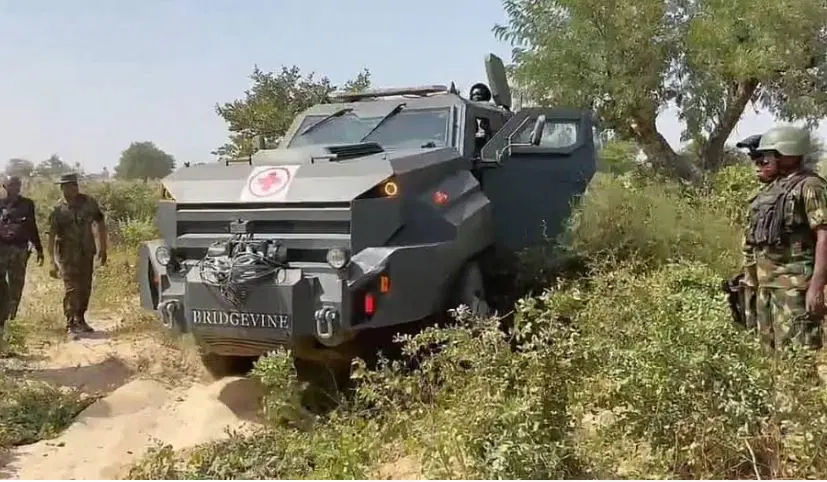

The General Officer Commanding of the 8 Division of the Nigerian Army, Major General Bemgha Koughna, has survived a coordinated ambush by suspected members of the Lakurawa Terrorists Group in Kebbi State, military authorities confirmed. The attack occurred as the senior commander’s convoy moved through a volatile corridor near Mayama Hill while en route to inspect frontline troops engaged in counterterrorism operations.
According to a statement issued by Lieutenant Colonel Olaniyi Osoba, Acting Deputy Director of Army Public Relations for the 8 Division and Sector 2 of Operation Fansan Yamma, troops responded immediately after coming under heavy fire in a forested area known for militant activity. Military forces returned sustained fire, killing five suspected attackers and forcing the remaining militants to retreat.
The North West region of Nigeria has faced a prolonged insurgency marked by banditry, terrorism, and attacks on military personnel and civilians. Operation Fansan Yamma, coordinated under the Joint Task Force North West, was launched to dismantle armed groups operating across vulnerable rural territories. Senior military commanders frequently conduct field visits to maintain operational oversight and troop morale, although such movements carry significant risk due to insurgent surveillance and ambush tactics.
The ambush unfolded as Major General Koughna’s convoy advanced toward operational zones where troops have intensified clearance operations. The terrain near Mayama Hill, characterized by dense vegetation and difficult access routes, has historically provided cover for armed groups seeking to evade military detection. The convoy’s movement through the area was part of ongoing efforts to strengthen frontline coordination and assess combat readiness.
Military officials said troops responded with superior firepower and tactical coordination. The swift counterattack neutralized five militants and disrupted what appeared to be a planned attempt to target senior command leadership. Security forces subsequently secured the immediate area, preventing further escalation.
A follow-up sweep led to the recovery of a substantial cache of weapons and operational materials. These included one OJC gun, one PKT machine gun, two AK-47 rifles, four rifle magazines, a bandolier of PKT ammunition, and multiple rounds of heavy-caliber ammunition.
Soldiers also recovered intelligence-linked items believed to be connected to militant logistics and mobility. Among the items were five motorcycles commonly used for rapid movement during attacks, two mobile phones, and a camel bag containing ₦840,000. The seizure of these materials is expected to aid intelligence gathering and future counterterrorism operations.
The decisive response prevented casualties within the convoy and ensured the safety of the senior commander and accompanying personnel.
Military operations in Kebbi and surrounding states have intensified in recent months as authorities seek to weaken militant networks. Field commanders have increased ground patrols, surveillance operations, and rapid response deployments to disrupt insurgent mobility and supply chains. The ambush underscores the persistent threat posed by armed groups, even as military forces expand their operational footprint.
Following the encounter, troops reinforced their presence across the affected corridor and heightened surveillance measures. Military officials indicated that additional clearance operations are underway to locate fleeing militants and dismantle remaining cells operating within the region.
The failed ambush highlights both the ongoing security challenges in Nigeria’s North West and the risks faced by military leadership in frontline environments. While the successful counterattack reinforces the army’s operational capability, the incident signals that militant groups remain active and capable of targeting strategic military movements, underscoring the importance of sustained counterterrorism pressure in the region.