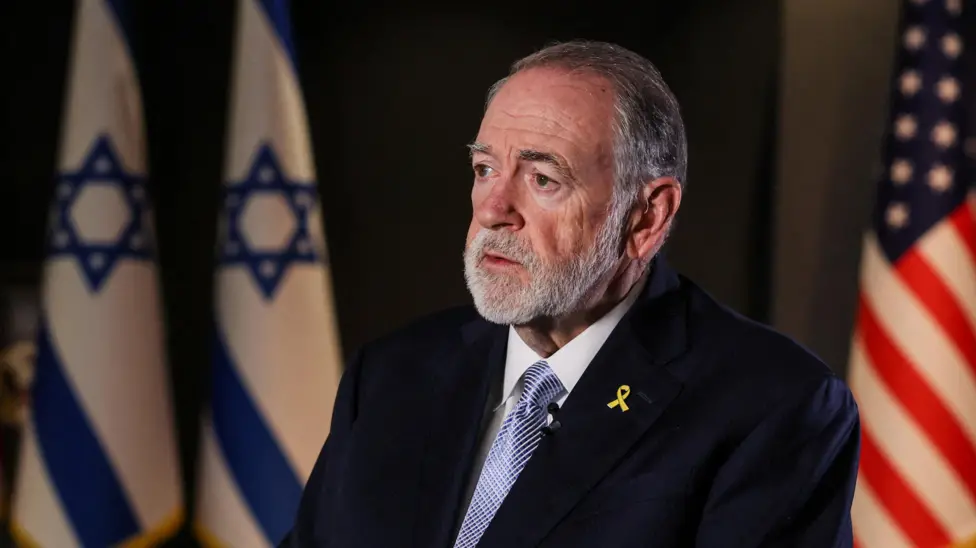

More than a dozen Arab and Muslim-majority governments have jointly condemned comments by Mike Huckabee after he suggested Israel would be justified in taking control of a vast swath of the Middle East on Biblical grounds. The coordinated rebuke underscores mounting diplomatic tension as the war in Gaza continues and regional stability remains fragile.
The remarks were made during an interview with conservative commentator Tucker Carlson, who asked whether Israel had a Biblical right to territory stretching between the Nile and the Euphrates. The area referenced encompasses large parts of the modern Middle East. Huckabee responded that it would be fine if Israel took it all, later describing the statement as hyperbolic and clarifying that Israel was not seeking to occupy the entire region.
The backlash was swift. In a joint statement issued by the United Arab Emirates on behalf of multiple governments, including Egypt, Jordan, Saudi Arabia, Qatar, Turkey, Pakistan and Indonesia, the comments were described as dangerous and inflammatory. The signatories warned that such rhetoric threatens regional stability and undermines ongoing efforts to end the war in Gaza.
The statement further argued that any suggestion Israel could exercise sovereignty over occupied Arab lands, including the West Bank, would violate international law. It reiterated support for a negotiated two-state solution and the establishment of an independent Palestinian state.
The declaration was also endorsed by key regional organizations, including the Arab League, the Organisation of Islamic Cooperation and the Gulf Cooperation Council. Their involvement elevated the statement from a bilateral protest to a broader multilateral condemnation, signaling unified concern across much of the Arab and Muslim world.
Huckabee has previously expressed support for Israeli annexation of the West Bank, positioning himself outside longstanding United States policy that backs a negotiated two-state framework. His remarks, even if characterized as exaggerated, revived fears of unilateral territorial expansion at a moment of acute regional volatility.
Israel has expanded settlement construction in the West Bank since capturing the territory in the 1967 war. The settlements are widely regarded as illegal under international law, including in a 2024 advisory opinion by the International Court of Justice. Israeli Prime Minister Benjamin Netanyahu has rejected that conclusion, maintaining that Israel disputes the legal interpretation and historical framing.
The renewed debate over sovereignty comes amid the continuing conflict in Gaza following the October 7, 2023 attacks by Hamas on Israel and the subsequent Israeli military campaign. Diplomatic efforts to broker ceasefires and address the humanitarian crisis have faced repeated setbacks.
Huckabee’s initial response during the televised exchange triggered immediate diplomatic engagement behind the scenes. Governments that have long coordinated on Palestinian statehood issues moved quickly to draft a unified response. The statement’s language reflected heightened sensitivity to rhetoric perceived as endorsing maximalist territorial claims.
The clarification from Huckabee that his remarks were hyperbolic did little to blunt the reaction. Officials in several capitals interpreted the comments as reflecting a broader political current that challenges internationally backed peace frameworks.
The controversy highlights a long-standing fault line in the Israeli-Palestinian conflict: competing claims over land and sovereignty, rooted in history, religion and security concerns. Over decades, shifts in political leadership in Israel, the United States and across the region have periodically revived annexation debates, particularly regarding the West Bank.
Regional governments have consistently framed such moves as violations of international law and obstacles to a negotiated settlement. The 2024 advisory opinion from the International Court of Justice added legal weight to that position, even as Israel dismissed the ruling as non-binding and politically motivated.
Diplomatic observers say the coordinated condemnation reflects growing unease across Arab and Muslim capitals about rhetoric that could inflame an already volatile situation. With Gaza still engulfed in conflict and ceasefire talks fragile, leaders appear intent on signaling unity against proposals seen as undermining territorial integrity and international legal norms.
The episode underscores the enduring sensitivity of territorial claims in the Middle East and the fragile state of diplomatic efforts to resolve the Israeli-Palestinian conflict. As fighting in Gaza continues and international pressure mounts for a sustainable settlement, statements that touch on sovereignty and annexation are likely to draw swift and forceful reaction from governments determined to shape the region’s political future.