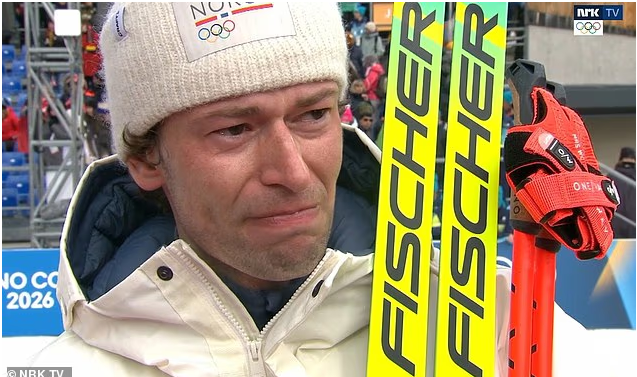

Norwegian biathlete Sturla Holm Lægreid stunned viewers on Tuesday after publicly admitting to cheating on his girlfriend during a live television interview moments after winning Olympic bronze in the men’s 20km individual race in Italy.
The 28-year-old had just secured his first Olympic medal at the Winter Games when he used his post-race interview with Norwegian broadcaster NRK to confess to what he described as his biggest personal mistake, shifting attention from sporting triumph to private turmoil.
Lægreid, who finished third in a tense competition at the Antholz-Anterselva Biathlon Arena on February 9, revealed that he had been unfaithful to his girlfriend of six months. Fighting back tears, he said he had met the love of his life six months earlier but made a serious mistake three months into the relationship. He described the recent days as the worst week of his life.
The emotional disclosure came as Lægreid reflected on the contrast between his professional success and personal regret. He said he wanted to be a good role model and believed it was important to admit mistakes, particularly when those actions hurt someone he deeply cared about. During the interview, he was visibly crying as he spoke.
Lægreid is one of Norway’s leading biathletes and has been regarded as a key figure in the country’s continued dominance in winter sports. Biathlon, which combines cross-country skiing and rifle shooting, is a discipline where Norway traditionally excels, and expectations surrounding its athletes are high.
The men’s 20km individual race is considered one of the most demanding events in biathlon, requiring endurance, precision shooting, and composure under pressure. Winning a medal in the event is a significant milestone, particularly at the Olympic Games, where margins are razor thin and competition is intense.
The race at the Antholz-Anterselva Biathlon Arena unfolded in nerve-jangling fashion, with athletes battling shifting conditions and the psychological strain of penalty-inducing shooting errors. Lægreid delivered a strong performance to secure third place, marking a breakthrough moment in his Olympic career.
Typically, such podium finishes are followed by celebrations and expressions of national pride. Instead, Lægreid used his interview to address his personal life, a move that surprised both viewers and commentators.
During the live broadcast, Lægreid said there was someone he wished could share the moment with him, acknowledging that she might not be watching. He admitted to cheating on his partner three months into their relationship and described the experience as deeply regretful.
He emphasized that athletes must take responsibility for their actions and that acknowledging wrongdoing was part of being a role model. The confession quickly became a talking point beyond the sporting result itself.
The most striking moment came when Lægreid, visibly emotional, contrasted his Olympic achievement with his personal loss. He suggested that while he had gained a medal, he felt he had lost something more valuable in his private life.
His remarks, delivered through tears, created a dramatic contrast between the celebratory setting of the Olympic venue and the gravity of his admission.
In the immediate aftermath of the broadcast, clips of the interview circulated widely, drawing mixed reactions from viewers and commentators. Some praised his openness and accountability, while others questioned the timing of such a personal disclosure during a global sporting event.
The episode highlights the increasingly blurred line between athletes’ public achievements and their private lives in an era of constant media scrutiny and live broadcasting.
As the Winter Games continue, attention will remain on Lægreid’s athletic performance. Whether the confession affects his focus in upcoming events or alters public perception of the Norwegian star remains to be seen.
Lægreid’s bronze medal marks a significant milestone in his career, but his unexpected confession has added a deeply human dimension to his Olympic story. As the Games progress, the incident serves as a reminder that even at the height of sporting achievement, athletes carry personal battles that can surface in the most public of moments.